Journaling apps compared
How We Feel vs Leeway
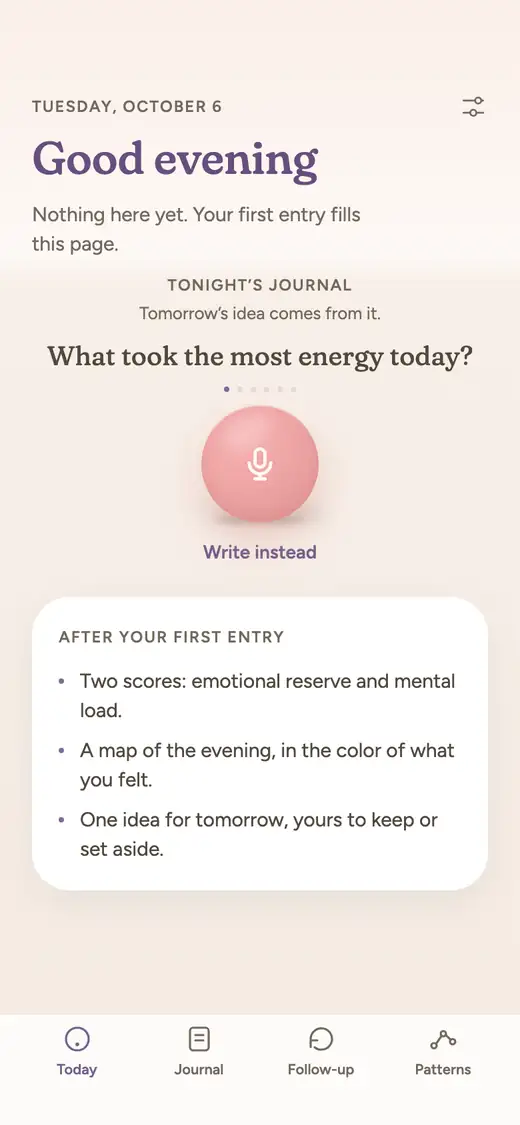
How We Feel is a free emotion check-in app from a nonprofit: you find a precise word for what you feel and try short strategies. Leeway is a new voice journal about to launch on iPhone: you say what happened and it names the feeling for you. Leeway is not released yet, so How We Feel is the one you can use today.
How We Feel is a free app from a nonprofit for putting words to emotions, conceived with the Yale University Center for Emotional Intelligence, and it often comes up when people look for a way to understand how they feel. Leeway covers some of the same ground from a different angle. It is a new app, about to launch on iPhone, where you talk about your evening instead of selecting a feeling from a list.
We build Leeway, and we say so on every page. What follows about How We Feel comes from its website, its US App Store page and its Google Play link, read on October 17, 2026. We list what it does well first, because for many people a free, science-led emotion tool is the right answer. Leeway is not released yet, with no date and no price announced.
If you want to build a richer emotion vocabulary and pick up short strategies for the moment, How We Feel is available now and costs nothing. If you find it hard to name a feeling at all, and would rather describe your evening and see what comes back, that is the gap Leeway is being built for.
At a glance
| Leeway | How We Feel | |
|---|---|---|
| How you journal | Answer one evening question out loud for a couple of minutes, morning or evening. Writing works too. | A check-in that helps you find a precise word for how you feel, with tags and a written note if you want one. |
| Voice | Voice first. Talking is the main way to make an entry. | Not described on its website or App Store page. |
| What you get after an entry | A title for your evening, your emotional reserve (the room you have left), your mental load (what is still turning), and a reflection in your own words. | Short strategies you can try right away, in video form. |
| Naming emotions | An AI names the emotion in your voice and in your words. You do not have to name anything, and you can correct it. | You find and choose the word, with the app guiding you toward more precise ones. |
| Over time | Follows your reserve and load from one entry to the next. After a few weeks, Patterns shows what weighs on you and what helps, and says so when there is not enough to tell. | Patterns across check-ins, with sleep, exercise and health trends from HealthKit, weekly insights, and a friends feature to share how you feel. |
| Something to do next | One small step for tomorrow, drawn from what you said. Try it, swap it, or set it aside. It waits for you in the morning. | A library of strategies, some taking one minute, which you choose for the moment. |
| Platforms | iPhone first. | iPhone (its App Store page also lists Apple Vision) and Android on Google Play. |
| Price | Not announced yet. | Free. Its App Store page says it is made possible by donations. |
| Availability | Not released yet. Waitlist open. | Available now on the App Store and Google Play. |
Where How We Feel is strong
- Free to use: it is run by a nonprofit, its App Store page says it is made possible by donations, and that page lists no in-app purchases.
- Backed by emotion science: its scientific team is led by Dr. Marc Brackett and the Yale Center for Emotional Intelligence, and the app was designed by scientists, designers, engineers and psychologists.
- Teaches words: the check-in is built to help you find the right word for how you feel, and its site says that over time you learn more precise words.
- A library of strategies: short step-by-step videos, some as quick as one minute, grouped under themes such as changing your thinking, moving your body, being mindful and reaching out.
- Privacy terms in plain language: its App Store page says your data is kept on your device unless you opt in to share anonymized check-ins for research.
What to keep in mind about How We Feel
- You do the naming: you look for the word yourself, rather than describing what happened and having a feeling named for you.
- Voice entry is not described on its website or its App Store page.
- You can add tags and notes to a check-in, but its pages do not describe a reflection written back to you from what you said.
- Patterns come from your check-ins and HealthKit data, with weekly insights. Its pages do not describe a running measure of how much room you have left.
Where Leeway is different
Describe your evening and let the feeling be named
How We Feel asks you to find the right word, which is a skill the app helps you build. Leeway takes the opposite route for the evenings when no word comes. You answer one question out loud for a couple of minutes, an AI names the emotion in your voice and your words, and you can correct it.
A reflection in your words, not only a label
A How We Feel check-in centers on the word you chose, with strategies and patterns around it. A Leeway entry ends with a title for your evening and a reflection in your own words, so what you said comes back to you in a form you can read the next day.
Two numbers that move with you
Leeway shows your emotional reserve, the room you have left, and your mental load, what is still turning. Both are followed from one entry to the next. After a few weeks, Patterns shows what weighs on you and what helps.
One step drawn from what you said
How We Feel lets you browse strategies and pick one. Leeway does the picking for that evening: one small step for tomorrow, taken from your own words. Try it, swap it or set it aside. It waits for you in the morning.
Which one to choose
Choose How We Feel if
You want a free tool to put more precise words on your emotions, with short strategies to use in the moment and no subscription at all. It works on iPhone and Android, it is available today, and its science team is led by Dr. Marc Brackett at the Yale University Center for Emotional Intelligence. If naming a feeling from a list feels natural to you, it does the job well.
Choose Leeway if
You would rather talk than tick a feeling, and you want to see your reserve and load move over weeks and end each evening with one small step. Leeway is new and not released yet. Join the waitlist and you will get one email when it opens on iPhone.
Questions
Is How We Feel really free?
Yes. Its website calls it a free journal for your wellbeing, its US App Store page lists it as free with no in-app purchases, and that page says it is made possible by donations to the nonprofit.
Who is behind How We Feel?
The How We Feel Project is a nonprofit. Its website says the product team is led by Ben Silbermann, co-founder of Pinterest, and its scientific team is led by Dr. Marc Brackett and the Yale Center for Emotional Intelligence.
Does How We Feel let you speak your entries?
Neither its website nor its App Store page describes voice entry. The check-in is built around choosing words for your emotions.
What does Leeway do that a check-in app does not?
Leeway starts from what happened rather than from a list of feelings. You answer one evening question aloud, a feeling is named from your voice and words, and you get your reserve and load, a reflection, and one small step for tomorrow.
When can I try Leeway?
Leeway has not been released. It opens on iPhone first, with no date or price announced yet. Joining the waitlist means one email when it is ready, and nothing else in between.