Journaling apps compared
Rosebud vs Leeway
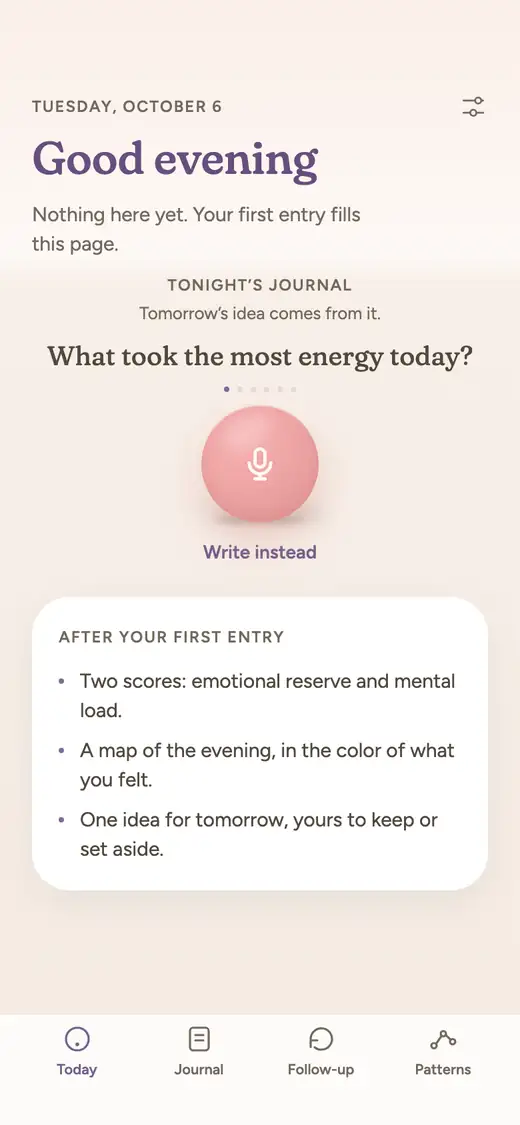
Rosebud is an established AI journal with long-term memory, weekly reports and a conversational style, on iPhone, Android and the web. Leeway is new and opening soon on iPhone: you answer one evening question out loud, see your emotional reserve and mental load, and keep one small step for tomorrow. Leeway is not released yet, so join the waitlist.
Rosebud and Leeway are both AI journals that answer back, so people who search for one often end up comparing it with the other. They start from different places. Rosebud is an established app that turns a journal into an ongoing conversation, with a memory of what you wrote before. Leeway is a new player, about to launch on iPhone, built around a single evening question that you answer out loud.
We make Leeway, so read this page knowing that. Everything about Rosebud below comes from its own website, its help center and its US App Store page, checked on October 17, 2026, and each strength listed is something Rosebud really does well. Leeway is not released yet. It opens soon on iPhone, with no date and no price announced.
The short version: if you want a conversation partner that remembers your whole journal and works across devices, Rosebud is the established choice today. If you want a short spoken evening check-in that ends in two numbers and one small step, Leeway is the new approach, and you can join the waitlist now.
At a glance
| Leeway | Rosebud | |
|---|---|---|
| How you journal | Answer one evening question out loud for a couple of minutes, morning or evening. Writing works too. | Text or voice entries with AI replies as you go, a morning intention, an evening reflection, plus guided and custom journals. |
| Voice | Voice first. Talking is the main way to make an entry. | Voice transcription with a hands-free mode, a voice mode, and spoken playback of replies. |
| What you get after an entry | A title for your evening, your emotional reserve (the room you have left), your mental load (what is still turning), and a reflection in your own words. | A reflection on the entry, and a weekly report with themes, emotional landscape and people mentioned. |
| Naming emotions | An AI names the emotion in your voice and in your words. You do not have to name anything, and you can correct it. | AI-assisted mood tracking and a weekly emotional landscape. Not described: naming a feeling from voice. |
| Over time | Follows your reserve and load from one entry to the next. After a few weeks, Patterns shows what weighs on you and what helps, and says so when there is not enough to tell. | Long-term memory across entries on the Bloom plan, and a weekly report. |
| Something to do next | One small step for tomorrow, drawn from what you said. Try it, swap it, or set it aside. It waits for you in the morning. | A goal tracker with AI habit and goal suggestions, and a morning intention. |
| Platforms | iPhone first. | iPhone, iPad, Android and web. Its help center says Mac users can install it from the App Store, where it is listed as an iPad app. |
| Price | Not announced yet. | Bloom: $12.99 per month, or $107.99 per year ($8.99 per month billed yearly), per its home page. Student and disability discounts available. Its App Store page also lists higher Thrive tiers. |
| Availability | Not released yet. Waitlist open. | Available now on the App Store, Google Play and the web. Its help center says the free plan is retired effective September 30, 2026. |
Where Rosebud is strong
- Memory across entries: with long-term memory switched on, a new entry can recall earlier ones, so you do not have to explain your situation again each time.
- Conversational: it responds while you write or speak, adds a reflection to each entry, and offers prompts that adapt to you, which suits people who think by talking something through.
- A weekly report that summarizes your week: writing stats, themes that keep returning, an emotional landscape of your mood trends, and the people who come up in your entries.
- Wide reach: iPhone, Android and the web on one account, with voice available in 20 languages according to its App Store page.
- Room to shape it: guided journals, custom journals, editable prompts, and the option to export everything you have written.
What to keep in mind about Rosebud
- Its evening reflection asks a variation of three questions (a highlight, a source of tension, something new), with an AI conversation you can extend, rather than one question answered aloud in a couple of minutes.
- Emotions show up as mood trends and a weekly emotional landscape. Its site does not describe naming a feeling from the sound of your voice, or two running measures such as reserve and load.
- Its help center says the free plan is retired effective September 30, 2026, while its home page still says Rosebud is free to use. Check the current terms inside the app before you sign up.
- Goals and habit suggestions are a separate layer. They are not described as one small step drawn from that evening's entry.
Where Leeway is different
One question, out loud, instead of an open conversation
Rosebud gives you a lot of room: you can write, talk or chat back and forth for as long as you like. Leeway narrows it on purpose. You answer a single evening question out loud for a couple of minutes, so there is no blank page and no conversation to steer. Writing works too if you would rather type.
A feeling named for you, which you can correct
In Rosebud your mood appears as trends across the week. Leeway names the emotion from your voice and your words after each entry, and you can correct it if it misses. You are never asked to pick a word or rate your day.
Reserve and load, evening after evening
After each entry Leeway shows two numbers: your emotional reserve, the room you have left, and your mental load, what is still turning. They follow you from one entry to the next. After a few weeks, Patterns shows what weighs on you and what helps, and says so when there is not enough to tell.
A small step that is waiting when you wake up
Rosebud offers goals and habit suggestions. Leeway draws one small step for tomorrow from what you said that evening. You can try it, swap it or set it aside, and it is there in the morning without you having to ask.
Which one to choose
Choose Rosebud if
You want an AI you can write or talk with at length, one that remembers your journal over months and runs on iPhone, Android and the web. It is available today, it has weekly reports and guided journals, and you can see its price before you decide. If you enjoy the back and forth of a conversation, Rosebud is built for exactly that.
Choose Leeway if
You would rather give two minutes of speech each evening than steer a conversation, and you want the day named, measured as reserve and load, and handed back as one small step. Leeway is new and not out yet, so there is nothing to download today. Join the waitlist and you will get one email when it launches on iPhone.
Questions
Is Rosebud free?
Rosebud is free to download. Its home page still says Rosebud is free to use and lists the Bloom plan at $12.99 per month or $107.99 per year, but its help center says the free plan is retired effective September 30, 2026. Check the current offer inside the app before you commit.
Can you talk to Rosebud instead of typing?
Yes. Rosebud supports voice transcription, a hands-free mode and a voice mode, and it can read its replies back to you. Its App Store page says voice works in 20 languages.
Does Rosebud remember what I wrote before?
Its help center describes long-term memory that lets a new entry recall earlier ones, and says memory is switched on automatically for Bloom subscribers. It also says Rosebud recalls topics better than exact dates.
How is Leeway different from Rosebud?
Rosebud is a flexible AI conversation around your journal. Leeway is a narrow evening routine: one question answered out loud, a feeling named from your voice and words, two numbers (emotional reserve and mental load), and one small step for tomorrow.
Can I use Leeway today?
Not yet. Leeway is new and has not been released. It opens on iPhone first, and the price and launch date have not been announced. The waitlist sends a single email when it opens.